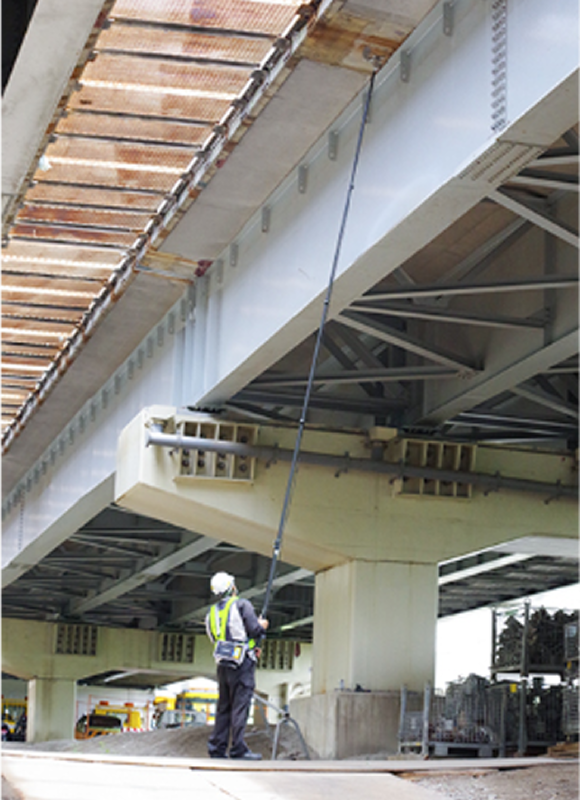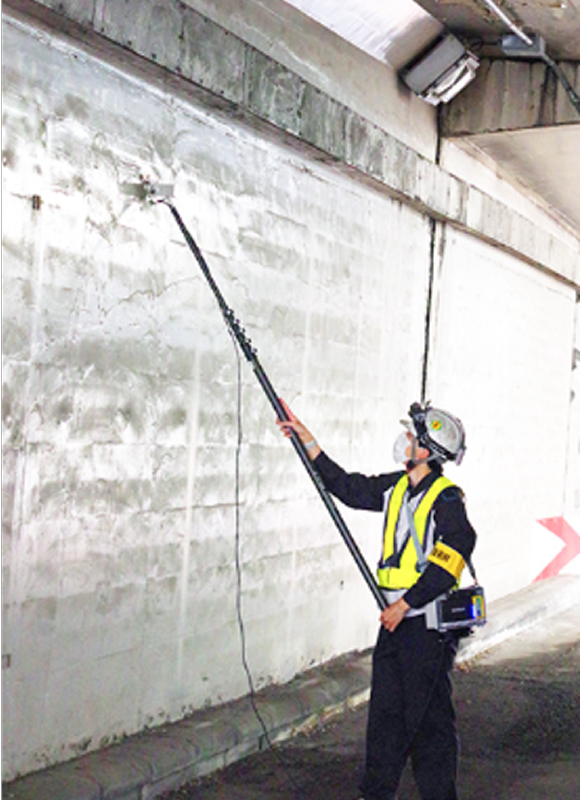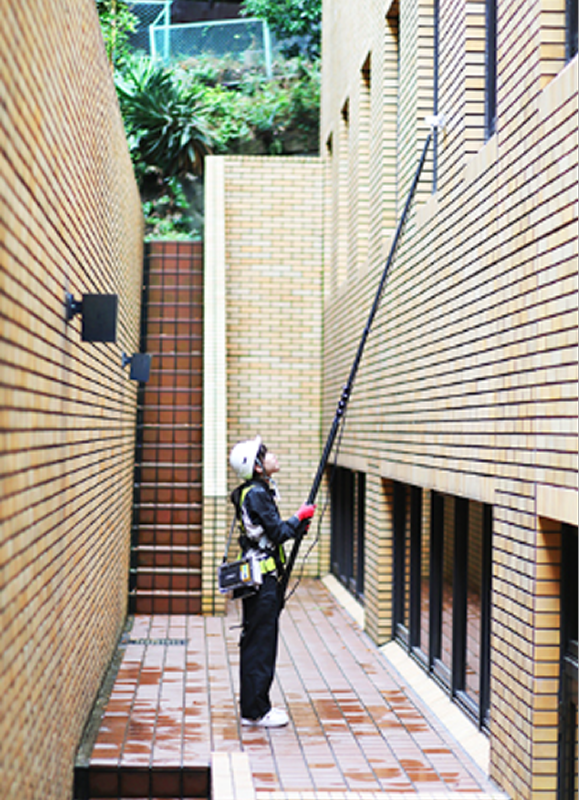

Kon-Kon
~Continuous Percussion Inspection Device~
Continuous Percussion Inspection Possible in Confined Spaces and Under Elevated Structures Inaccessible to Aerial Work Platforms
Continuous Percussion Inspection Possible in Confined Spaces and Under Elevated Structures Inaccessible to Aerial Work Platforms
The ideal technology for concrete percussion inspection in locations where aerial work platforms are difficult to position, or in confined spaces. Supports inspections in locations that were previously difficult to access.
- Patent No.7312102
- NETIS Registration No.KT-210005-A
- Inspection Support Technology Performance Catalog (Bridges & Tunnels) Registration Nos. BR020035-V0226 Non-Destructive Testing (Bridges), TN020024-V0024 Non-Destructive Testing (Tunnels)
Technology & Product Overview
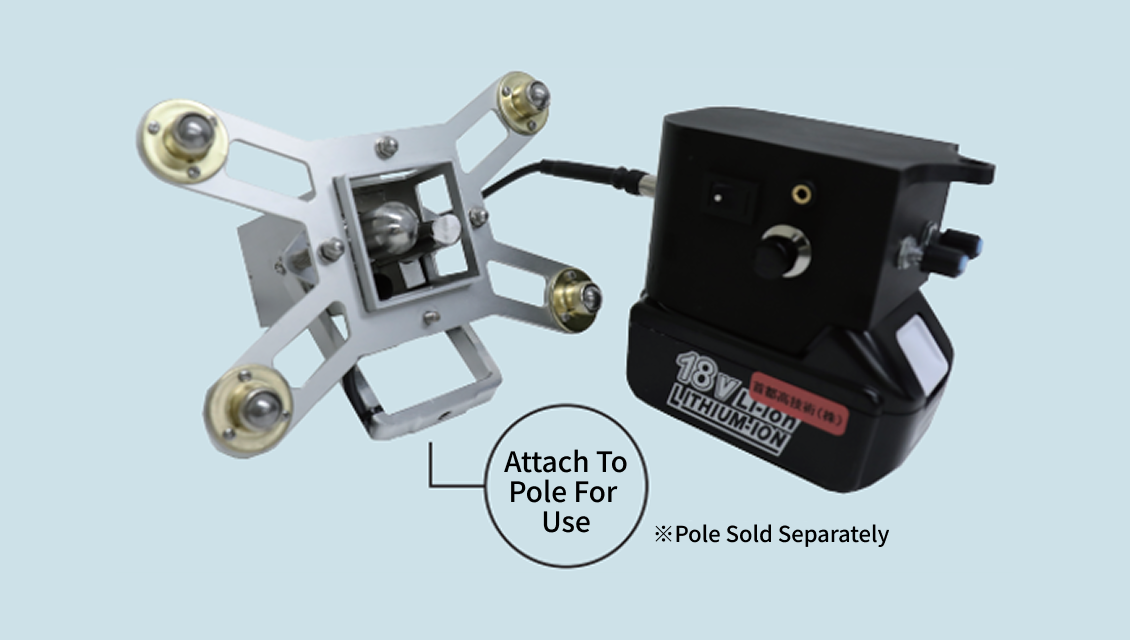
The 'continuous percussion device' at the tip of the pole operates with automatic repetition, enabling efficient percussion inspection of concrete.
Features
- The microphone attached to the continuous percussion device allows the striking sound to be heard from ground level.
- A compact, lightweight design (500g) makes inspection easy for anyone.
- The movable joint between the continuous percussion device and the pole allows the contact angle with the concrete surface to be freely adjusted.
- Inspections can be carried out at heights of up to 8.0m.
- The continuous percussion device can also be fitted with chalk markers or a compact camera (please contact us for details).
Specifications
| Continuous Percussion Device Dimensions | 120×180mm (Striking section: 50×50mm) |
|---|---|
| Continuous Percussion Device Weight | 500g (Striking action by solenoid coil reciprocating motion) |
| Striking Frequency | 1–10 times/sec (adjustable) |
| Striking Ball | Stainless steel |
| Pole | Telescopic, maximum 7,500mm (1,500mm×5 sections, carbon fiber) |
Usage Examples
- Inspection of locations where aerial work platforms are difficult to use
- Inspection of tunnel sidewalls
- Tile inspection of buildings
Also used for inspections of parking structure ceilings and station buildings.